510 Area Code: Oakland, California
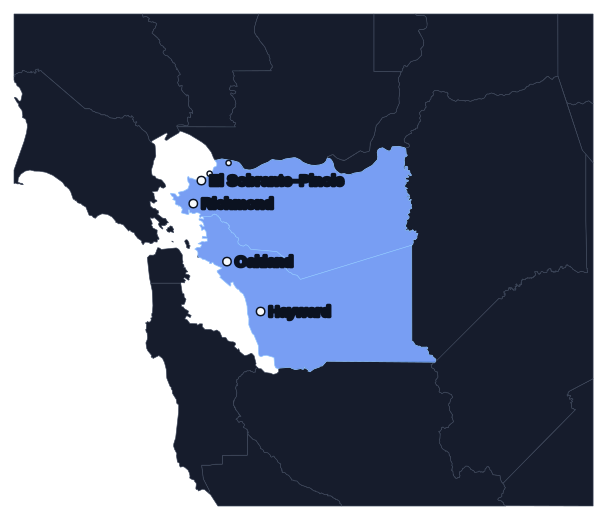
Where is area code 510? Area code 510 is in California. It serves Oakland, Hayward and Richmond, covering Alameda County and Contra Costa County. It is in the Pacific time zone (UTC−8, or UTC−7 during daylight saving time).
What area code is 510? 510 is a geographic area code, assigned by NANPA to California. It entered service on September 2, 1991 as a split from area code 415. Overlay code 341 (2019) is in the same overlay complex in NANPA's records, so local calls there are dialled with all 10 digits. Area code 925 (1998) was later split off from it. Unlike a toll-free code it belongs to a place, but caller ID can show any number, so a 510 call does not prove the caller is in California.
Local time now:—
Consumers have filed 6,727 unwanted-call complaints against 4,951 different 510 numbers, 744 of them with the FTC in the last 30 days. Look up the exact number that called you.
Area code 510 at a glance
- State
- California
- Main cities
- Oakland, Hayward, Richmond, El Sobrante–Pinole
- Counties
- Alameda County, Contra Costa County
- Local time
- —Pacific
- In service since
- September 2, 1991
- Split from
- 415
- Overlay code
- 341 (2019)
- Codes split off
- 925 (1998)
- Local dialing
- 10 digits (area code + number)
- From abroad
- +1 510 xxx xxxx (US country code +1)
- Exchanges
- 13 rate centers, 785 prefixes
Sources: NANPA area code and central office code records (refreshed weekly); cities and counties matched from US Census Bureau and USGS place names.
Area codes near 510
Related to 510: 415 (split from), 341 (overlay), 925 (split off).
Next door, by county: these codes have exchanges in counties that touch the ones 510 serves. Codes in the same box overlay each other. The list is approximate, since area codes follow exchange boundaries, not county lines.
- 209Stockton350Stockton
- 408San Jose669San Jose
- 650Palo Alto
- 279Sacramento916Sacramento
- 369Santa Rosa707Santa Rosa
All California area codes (list, map and time zones) · Find the area code for any ZIP · Area code time zones · All US area codes
Area code boundaries are set when a code is split or overlaid: state utility commissions decide the relief plan and NANPA administers the codes (47 CFR § 52.19, NANPA relief planning FAQ).
Most-reported 510 numbers
Ranked by FTC Do Not Call complaints this month, then all-time FTC and FCC complaints. Only numbers with enough complaints for a full report page are listed. Click one for what it was reported for and where.
- (510) 427-715116 this month2026-11-02
- (510) 312-4790Dropped call / no message8 this month2026-11-05
- (510) 291-3483Impostor (government, business, family)6 this month2026-10-29
- (510) 254-3156Impostor (government, business, family)5 this month2026-11-06
- (510) 992-88301 report2026-10-24
- (510) 254-37120 reports
What calls from 510 numbers are about
2,244 FTC Do Not Call complaints about 510 numbers since Jul 24. The most common named subject is impostor calls (people pretending to be a government agency, a business or family), at 10% of complaints (60% of those were recorded messages). Overall, 57% of callers who answered said the call was a robocall.
FTC complaint subjects
- Other / unspecified1,07748%
- Dropped call / no message32715%
- Impostor (government, business, family)21810%
- Debt reduction2059%
- No subject given1235%
- Energy, solar & utilities984%
- Home improvement & cleaning583%
FCC complaints by call type, last 2 years
- Live Voice13054%
- Prerecorded Voice7431%
- Text Message3615%
15% of recent FCC complaints about 510 numbers are about text messages, not calls.
When 510 spam calls come in
32% of complaints that give a call time describe calls between 10am and 1pm. 94% came Monday to Friday, most on Wednesdays, the pattern of call-center robocall campaigns that run on business hours. Times are as consumers reported them to the FTC.
By hour of the day
By day of the week
Is it getting worse?
710 FTC complaints about 510 numbers in the last four weeks, up 33% on the four weeks before. FCC complaints about 510 numbers peaked in 2015 (974); the FTC's daily Do Not Call data has carried most of the volume since mid-2026.
FTC complaints per week
FCC complaints per year
Years shown as '15 to '26; the current year is partial.
Who gets these calls
77% of the FTC complaints about 510 numbers came from California residents, but only 39% from people with 510 numbers themselves. The calls are mostly regional rather than aimed at 510 phones specifically.
Where complainants live
- California1,72877%
- Florida442%
- Tennessee331%
- Texas291%
- Virginia281%
What people with 510 numbers report
People whose own number starts with 510 filed 4,112 FTC complaints since Jul 24. 22% were about calls showing another 510 number. The most common named subject was debt-relief pitches.
Area codes on the calls they reported
- 510 (same code)88522%
- 833 (toll-free)1644%
- 4081604%
- 877 (toll-free)1564%
- 855 (toll-free)1233%
Busiest 510 prefixes this month
FTC complaints in the last 30 days, grouped by the first six digits. When one prefix collects complaints about many different numbers, a campaign is usually cycling through that block. The carrier is who NANPA assigned the prefix to, not who made the calls.
| Prefix | Complaints | Numbers | Carrier | Exchange |
|---|---|---|---|---|
| (510) 288-xxxx | 33 | 32 | Onvoy (Sinch) | Oakland |
| (510) 291-xxxx | 23 | 18 | Onvoy (Sinch) | Oakland |
| (510) 281-xxxx | 20 | 20 | Onvoy (Sinch) | Oakland |
| (510) 440-xxxx | 20 | 19 | Pacific Bell (AT&T) | — |
| (510) 427-xxxx | 16 | 1 | Verizon Wireless (Cellco Partnership) | Hayward |
Carriers operating in 510
NANPA has assigned 785 510 prefixes (NPA-NXX central-office codes) across 13 rate centers: 34% to wireless carriers, 66% to landline and VoIP operators; 65% are pooled blocks shared by several carriers. 1 prefix was assigned in the last 12 months (newest 2026-02-25). The carrier holding a prefix is who the number was issued through. It says nothing about who is calling, since caller ID is routinely spoofed.
| Carrier | Type | Prefixes | Rate centers | Newest assignment |
|---|---|---|---|---|
| Pacific Bell (AT&T) | Incumbent landline (ILEC) | 277(35%) | 13 | 2012-11-30 |
| AT&T Mobility (New Cingular Wireless PCS) | Wireless | 78(10%) | 9 | 2024-02-20 |
| T-Mobile USA | Wireless | 65(8%) | 11 | 2024-05-31 |
| Verizon Wireless (Cellco Partnership) | Wireless | 60(8%) | 6 | 2021-08-05 |
| Metro by T-Mobile (MetroPCS) | Wireless | 45(6%) | 9 | 2018-09-17 |
| MCImetro (Verizon Business) | Competitive / VoIP (CLEC) | 37(5%) | 12 | 2004-08-18 |
| Onvoy (Sinch) | Competitive / VoIP (CLEC) | 37(5%) | 11 | 2021-11-18 |
| Level 3 (Lumen) | Competitive / VoIP (CLEC) | 34(4%) | 12 | 2016-06-09 |
| Bandwidth.com | Competitive / VoIP (CLEC) | 29(4%) | 13 | 2020-12-11 |
| Teleport Communications America, LLC | Competitive / VoIP (CLEC) | 19(2%) | 11 | 2023-06-28 |
| U.S. Telepacific CORP. dba Tpx Communications | Competitive / VoIP (CLEC) | 18(2%) | 9 | 2018-03-16 |
| Comcast (Xfinity Voice) | Competitive / VoIP (CLEC) | 12(2%) | 8 | 2018-02-20 |
Largest rate centers (exchanges) by prefixes: Oakland (415), Hayward (117), Richmond (53), El Sobrante–Pinole (28). Source: NANPA Central Office Code Utilized Assignments (public, refreshed weekly).
What to do about calls from 510 numbers
Before you call back
- Impostor (government, business, family) is the top named complaint here. Hang up and call the agency, bank or relative back on a number you already know. Government agencies don't demand payment by gift card, wire transfer or crypto. Read about Social Security impostor calls and fake bank fraud calls.
- Look up the full number above. A missed call from 510 with no voicemail is usually a robocall; anyone who needs you will leave a message.
- Block repeat callers: iPhone, Android, or your carrier's free filter (Verizon, AT&T, T-Mobile).
Report it in California
- Unwanted sales calls and robocalls: donotcall.gov (FTC). Scams and fraud: ReportFraud.ftc.gov.
- Spoofing, texts and call-blocking problems: FCC consumer complaints.
- State complaints: California Attorney General.
- California formally adopted the FTC's National Do Not Call Registry as its own state list rather than running a separate one, so a single free registration at donotcall.gov covers you. State authorities can still enforce against telemarketers who ignore it, in addition to any federal penalty.
Your FTC and FCC reports are published (without your name or number) in the datasets this page is built from. How to report unwanted calls.
Area code 510: questions answered from the data
Where is area code 510?
Area code 510 is in California. It serves Oakland, Hayward and Richmond, covering Alameda County and Contra Costa County. It is in the Pacific time zone (UTC−8, or UTC−7 during daylight saving time).
What area code is 510?
510 is a geographic area code, assigned by NANPA to California. It entered service on September 2, 1991 as a split from area code 415. Overlay code 341 (2019) is in the same overlay complex in NANPA's records, so local calls there are dialled with all 10 digits. Area code 925 (1998) was later split off from it. Unlike a toll-free code it belongs to a place, but caller ID can show any number, so a 510 call does not prove the caller is in California.
What time zone is area code 510 in?
Area code 510 is in the Pacific time zone (UTC−8, or UTC−7 during daylight saving time). The current local time is shown at the top of this page.
Which area codes overlay 510?
341 (in service 2019) serves the same area as 510. New numbers there can be issued with any of these codes, and local calls need all 10 digits. A spoofed call can display any of them.
Which area codes are near 510?
By county, the closest area codes to 510 are 209 / 350, 408 / 669, 650, 279 / 916 and 369 / 707. Codes joined by a slash overlay each other and cover the same area. This is approximate: area codes follow exchange boundaries, not county lines.
Is area code 510 a scam?
No. 510 is a regular area code that NANPA assigned to California. A code cannot be a scam, but callers can make caller ID show any number, including a local-looking 510 one, which the FCC calls neighbor spoofing. Judge the call by what it asks for, and look up the exact number. Consumers have filed 6,727 unwanted-call complaints about 4,951 different 510 numbers.
What are calls from 510 numbers usually about?
Since Jul 24, consumers filed 2,244 FTC Do Not Call complaints about 510 numbers. The most common named subject was impostor calls (people pretending to be a government agency, a business or family): 10% of complaints, 60% of them recorded messages. Across all subjects, 57% of callers who answered the question said the call was a robocall.
When do 510 spam calls happen?
32% of the complaints that give a call time describe calls between 10am and 1pm, and 94% came on weekdays, most often on Wednesday. Times are as consumers reported them.
Are calls from 510 numbers really local?
Not necessarily. 77% of the FTC complaints about 510 numbers came from California residents, but only 39% from people with 510 numbers themselves. The calls are mostly regional rather than aimed at 510 phones specifically.
Are 510 robocalls increasing?
In the four weeks to Nov 11, consumers filed 710 FTC complaints about 510 numbers, 33% more than the four weeks before.
How do I report a 510 scam call in California?
Report unwanted sales calls and robocalls to the FTC at donotcall.gov, and scams to ReportFraud.ftc.gov. The FCC takes complaints at consumercomplaints.fcc.gov. In California, the California Attorney General also handles consumer complaints about scam calls. Reports feed the public data this page is built from.
Other California area codes
Sources: FTC Do Not Call complaints (unverified consumer reports), published every weekday and available here from Jul 24; FCC Consumer Complaint Data, public record, imported nightly; NANPA numbering records (NANPA area code reports; cities and counties are matched from exchange assignments, so they are approximate); the FCC on spoofing. A number appearing here means consumers reported calls that displayed it. Caller ID can be spoofed.